Showing posts with label giant goby. Show all posts

Wednesday, 15 November 2017

Shoresearch Week 2017

Shoresearch week 2017 was held between October the 6th and 10th during the largest spring tides of the autumn, and despite being slightly later in the year than in previous years we were very lucky with the weather and we had a great team of surveyors join in! This is a five day rockpooling mission taking in all five of Cornwall's Voluntary Marine Conservation Zones - St Agnes, Fowey, Helford, Polzeath and Looe. Here are some highlights in photos:

Happy Shoresearch crew on the shore at Readymoney Cove Fowey

Anthea with sea scorpion Taurulus bubalis,

Tiny cushion star, Asterina phylactica  found by Heather at Readymoney, Fowey  Matt Slater

Dahlia anemones -  Polzeath -  Adele Morgan

Blue Rayed Limpet - Matt Slater 

Celtic Sea Slug, Onchidella celtica, Readymoney, Fowey  Adele Morgan

Cocks Comb weed Adele Morgan, Prisk Cove

Pterocladiella capillacea - St Agnes Matt Slater 

Gem Anemone Aulactinia verrucosa Matt Slater

C
Checking a fish trap

Giant goby 22cm long found at Prisk Cove by Sue Scott 

Giant goby  at Hannafore - found by Niki Clear

Matt and common prawn

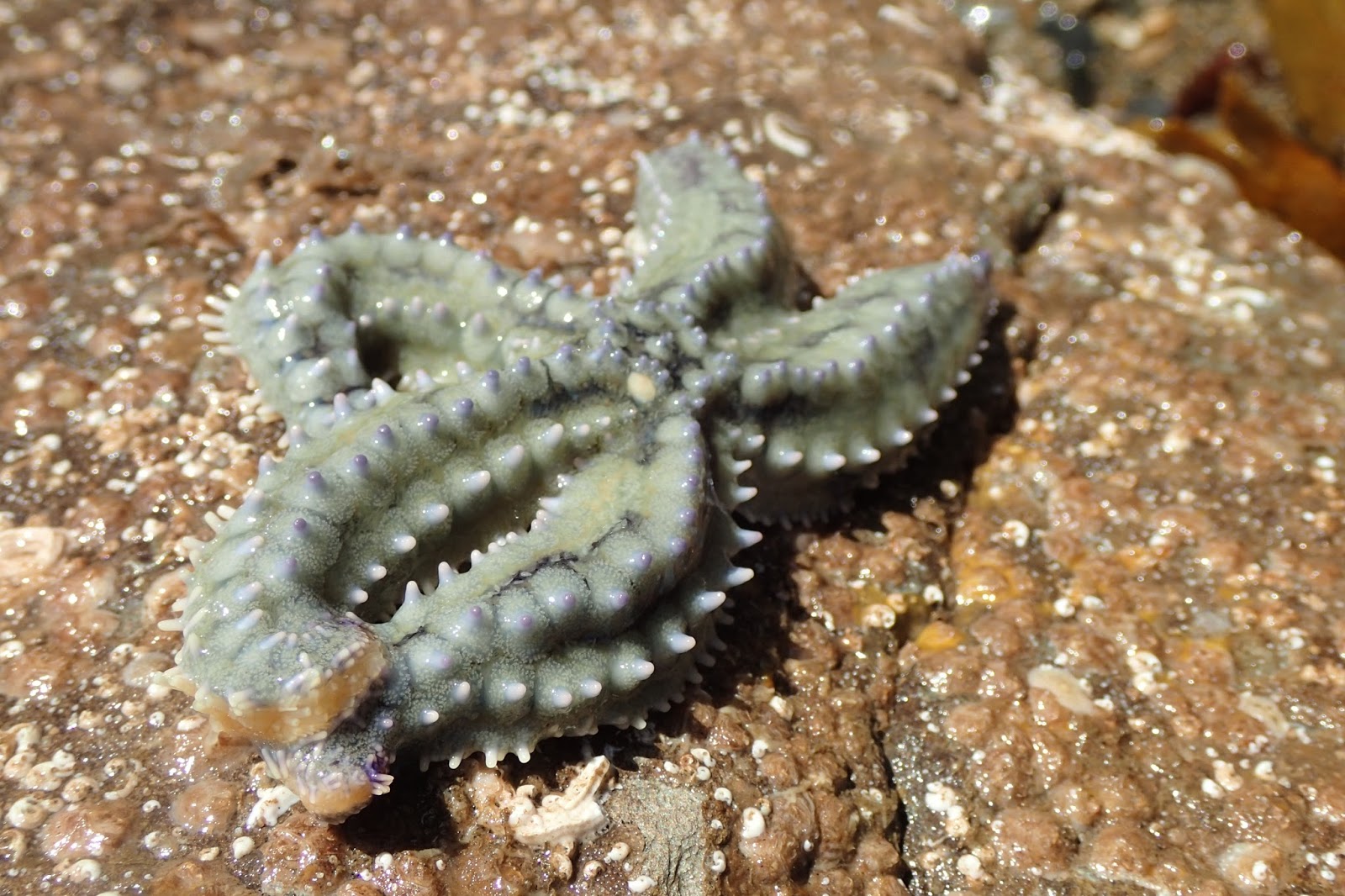
Spiny Starfish, Marthasterias glacias

Juvenile Montagu's blenny Coryphoblennius galerita Matt Slater 

Devonshire cup coral Carophyllia smithii


Cancer pagurus - the Pasty Crab  Matt Slater

Polyides rotunda - red seawed Matt Slater 

Sea Lemon, Doris pseudoargus Hannfore point, Looe  photo Matt Slater 

Common Shanny Photo Adele Morgan
 Common Shanny shows its impressive teeth! used for biting the legs off barnacles! 
Sphareoma serratum -  Photo Matt Slater
Sphareoma serratum  - an isopod which rolls in a ball when disturbed! Was abundant amongst rocks on the high shore, Prisk Cove.

Velvet swimming crab Polzeath 
Tompot blenny, St agnes photo Matt Slater 


To celebrate the end of Shoresearch Week Adele made this delicious vegan chocolate cake! 


Giant Gobies found at Looe Island!

Giants discovered on Looe Island! 

Cornwall Wildlife Trust Living Seas Manager Ruth Williams with giant goby

On a recent Cornwall Wildlife Trust survey of marine life on their Looe Island Nature Reserve marine experts were thrilled to discover a rare species lurking within the island’s rockpools.

The giant goby, Gobius cobitus is the largest species of goby to be found in UK waters growing to a whopping 27cm maximum length. Few people have heard of this elusive species which dwarfs all other gobies, but its UK stronghold is in Cornwall and South Devon, with increasing numbers of records being made each year. This discovery, the first for Looe Island, further highlights the amazing marine life found in Cornwall’s only Marine Nature Reserve.

Giant gobies are warm water marine fish which range from the Mediterranean, along the Atlantic coasts of Spain and France and north as far as the South West of England. It is possible that we may witness an extension north of this species’ range due to climate change in coming years so it is particularly important to survey them.

Giant gobies are protected by the Wildlife and Countryside act 1981 so it is illegal to disturb them without a Natural England Licence. Matt Slater, Marine Awareness Officer for Cornwall Wildlife is the proud holder of a licence to humanely capture and study this species.

Matt Slater said,

“We have carried out surveys in lots of locations around Cornwall and I am starting to be pretty good at thinking like a goby and predicting where they are likely to be, but it is still a real thrill to discover a new population of them in a new site!”

Giant gobies have never been recorded before on Looe Island as far as we are aware. In one pool two small giant gobies were found and in another pool one giant was discovered measuring 23cm (9 inches) in length.


Giant gobies are chunky, robust fish and are members of a large family of rockpool fishes all having distinctive, fat rubbery lips, tiny scales and two dorsal fins. Gobies are well adapted to life on the shore and the giant goby can be distinguished by it’s size and its fleshy, lobed pelvic fin which is used as a suction pad.

The annual Looe Island survey, which is carried out in August, was well attended this year by a range of local naturalists, Cornwall Wildlife Trust staff and volunteers from Looe Marine Conservation Group. As well as carrying out a fish survey of rockpools other surveys were completed by Cornwall Seal Group. This included surveys of seals, birds and butterflies as well as monitoring of the rocky shore. The records collected all help to understand, manage and protect the island’s wildlife.

Looe Island Nature Reserve is a truly special place home to an amazing array of wildlife, all thriving in this secluded and unspoiled corner of Cornwall.

To arrange a visit to the island please visit www.cornwallwildlifetrust.org.uk/looeisland
If you would like to get involved in helping out on shore surveys please email Shoresearch@cornwallwildlifetrust.org.uk
Giant Goby Looe Island 

Tuesday, 15 April 2014

Giant gobies found at Newquay!

WOW what a a day!

A fantastic ERCCIS fish identification day held at Cornwall college Newquay, organised by Sue Scott and led by Doug Herdson, marine fish authority, was topped off by the discovery of four giant gobies in a Newquay rockpool!

This is the first proper record of this species found in Newquay and further evidence that this area is worthy of protection.

The giant goby is a southern species with a very limited distribution in the south west - Cornwall and South Devon are as far north as they currently range. They live in deep pools usually on the upper shore. They are protected by schedule 5 of the Wildlife and Countryside act 1981 and are a Biodiversity Action Plan species.

 What a fantastic find for Newquay!
Giant goby Gobius cobitus photo copywrite Matt Slater


The only way to prove they are giant gobies are two pointed lobes found at the front edge of the pelvic fin cup on the underside of the fish. Natural England staff were there to witness the discovery!

this is why we all love living in Cornwall! 

Thanks to Sue, Doug and Becs Allan, and all who took part in this fantastic day! 

Wednesday, 19 February 2014

Call to Action for MCZs

It was a fantastic turnout at last weeks Shoresearch training evening. Thanks to all those who came from all ends of the county. A total of 27 volunteers attended, including a number of new recruits, several experienced VMCA committee members and volunteers, several marine scientists, local marine lecturers and even staff from Natural England.

It is really great that so many people want to get involved with the Shoresearch programme. I think it bodes well for the year to came and hope that we get a good set of results. Collecting good quality verifiable records of rare shore species will be vital as this summer will be last chance we have to provide much needed data to back up the next tranche of MCZs.  We need a coherent network of Marine Conservation zones around our coast for the long term benefit of our valuable marine habitat and we only have until September to do this so this is a real call for action! 


Sites we need to get data for are Mounts bay rMCZ, Lands End rMCZ, Newquay and Gannel Estuary rMCZ , Hartland point to Tintagel rMCZ, and St Ives Bay.
It is important that we get out and survey as much as we can in these areas this year as the data collected will be really useful in arguing the case for these zones will be vital to ensure that we get a cohesive network of MCZs throughout our waters.

Keep looking out for core species and don't forget that there are a few more species not included that will be really significant if you find them: these are;

  • Eel grass (live, not washed up on the beach)
  • Stalked Jellyfish - you must take good macro photos and get GPS positioning to go with the photos.
  • Giant Goby for more information on these see my earlier post.
  • Peacocks tail sea weed,
  • Maerl beds,
  • Honeycomb worm reefs,
  • Under boulder communities (boulders are classed as rocks larger than 25cm diameter and there must be several encrusting species - ascidians, sponges, bryozoans, keel worms etc living beneath the rocks. Please take lots of photos,
  • Couches goby, 
  • Gooseneck barnacle Pollicepes pollicepes 
  • European Eel,
  • Native oyster,
  • Mussel beds  -where mussels grow on soft substrates and themselves create a new habitat


Don't forget carrying out a survey is easy and if you can't make many of the organised survey dates you are encouraged to go out and carry out your own shoresearch. All you need is a digital camera, a recording sheet (which can be downloaded here) and a GPS or GPS enabled smart phone.
Please remember though to keep safe on the shore and follow the sea shore code!

Send your data and photos in to me at matt.slater@cornwallwildlifetrust.org.uk

Don't forget you can also use the Shoresearch Cornwall dropbox - just drop me an email and I will send you an invite!


Giant goby