Showing posts with label PANACHE. Show all posts

Thursday, 17 April 2014

Fantastic Marazion yeilds strange surprises!

The weather stayed fine for our Marazion Marine day yesterday and a large group of shoresearchers turned out for what proved to be another epic day on the shore!
We had a great turnout of families for the public rockpool ramble and, who could fail to be impressed by the beautiful eel grass beds and colorful seaweeds and anemones we found?
People were amazed at the variety of crabs found on the shore - edible crabs, velvet crabs, shore crabs, Montagu's crabs, long horned porcelain crabs, broad clawed porcelain crabs, hermit crabs and squat lobsters were all in abundance!

The water clarity was amazing at the edge of the eel grass beds (which we were careful not to walk on!)
And living among seaweeds were found yet more stalked jellyfish Lecernaryopsis cruxmelitensis.
David Fenwick found an incredibly rare double headed stalked jellyfish.A Siamese twin version of the Maltese cross species.

Thanks to all the volunteers who came along - most got the chance to see a stalked jellyfish and all enjoyed exploring a fantastic shore.

Rare to see a s legged cushion starfish! 

A beautiful gem anemone found by Tim Caulfield

Water clarity in the shallows around the edge of the eel grass bed was astoundingly good 

A five bearded rockling with a very unusual forked barbel

A beautiful day on the Shore

Zoe at the shorelab

Red sponge found in an upper shore pool


Wednesday, 2 April 2014

PANACHE conference at DOVER

Last week three Cornwall Wildlife Trust Marine team staff attended a PANACHE conference held at St Margarets Bay near Dover. It was a good conference and a chance to further develop our links with our french counterparts! Lots of exciting events, surveys and dives are being planned on both sides of the channel for 2014.

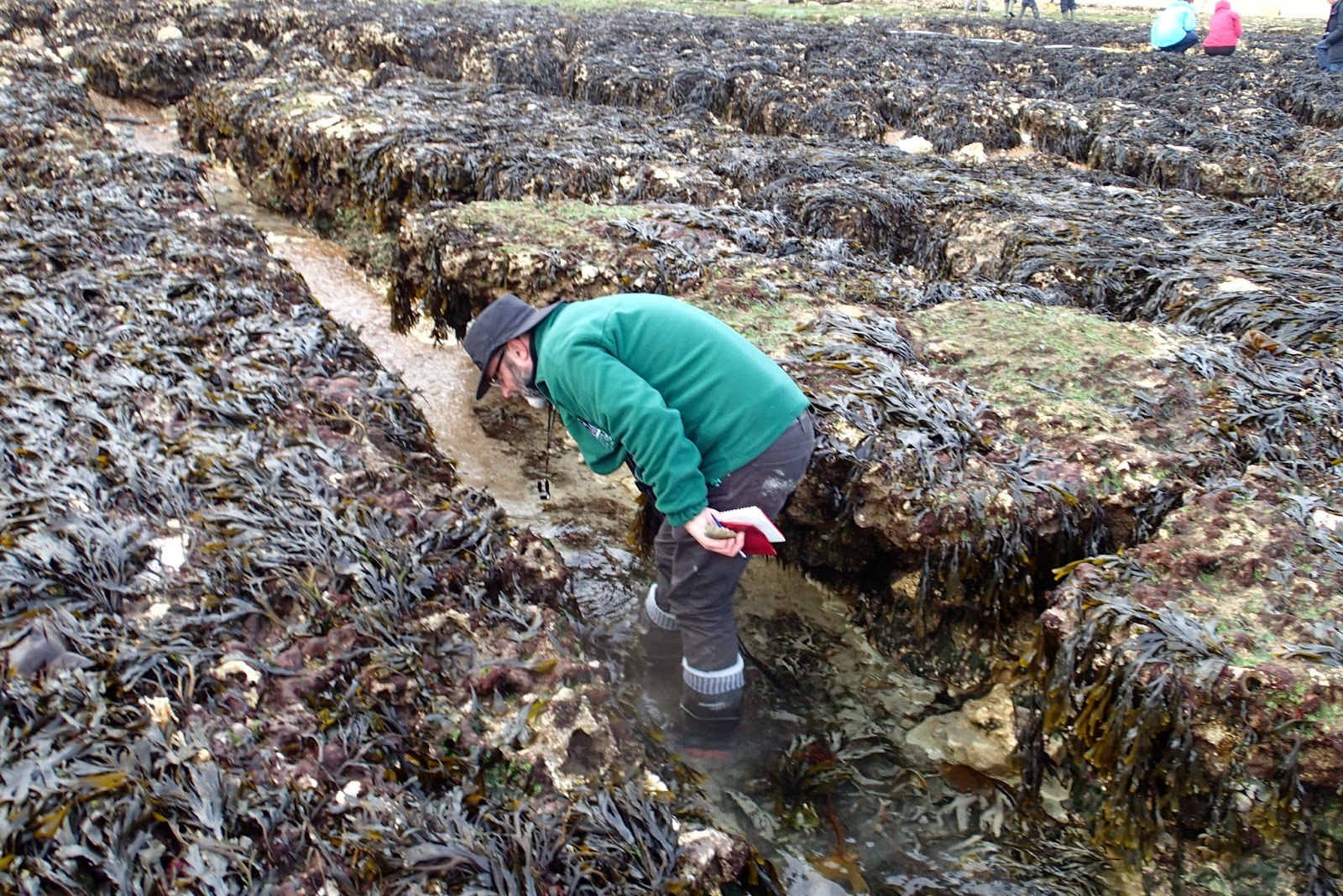
On day 2 we all went down to the shore to see what the intertidal looks like below the white cliffs of Dover. The chalk bed rock is soft and thus mussels and barnacles are not all that common - they just get washed off.
Limpets make impressive trails as they graze the rocks for algae with their iron reinforced radulae they remove a layer of chalk. You can see the freshest trails are the whitest, older trails get gradually more re algaed up!
Brilliant limpet trails


Beautiful gullies were formed as freshwater has dissolved the chalk. Patrick from Fish Watch forum was a bit unimpressed with the sparseness of fish life in the pools, the water is still very cold in the channel at the moment but he was pleased when we found a BAP species - a juvenile eel (Anguilla anguilla).


Tim Ferrero of Hampshire and Isle of White Wildlife trust explores a gully
 There was a huge diversity of algae species found.

Flat topshells are a climate change indicator species and have only recently reached this stretch of coast 


Monday, 2 December 2013

Shoresearch en Francais


Last week all the partners of the PANACHE project got together for a meeting in Boulougne-Sur-Mer in Normady. It was a good opportunity to report how well the Shoresarch programme is going here in Cornwall. Information is now coming in from all along the British coast and hopefully our French counterparts will be carrying out more surveys like ours in the future too! 
Highlight of the meeting was a field trip out on the shore to La Pointe de la Creche. At first sight this coast did not look very exiting but out on this rocky point - we found a good range of species including a couple we don't find in Cornwall!

This was so exiting - found in the mortar cracks on the outer breakwater - a graspid crab most likely an invasive species - graspids are very agile little crabs found on the shore in (usually) much warmer climes. Although it certainly looks like Hemigraspus sanguinea as we weren't able to pull it out from its lair we were not able to get proper closeup look so it may be the closely related Hemigraspus takanoi (from japan), which has furry claws. Hemigraspus sanguinea was first found in Europe in 1999 and it is now fairly widely distributed along the channel coast but has yet to arrive in The Uk. Boulogne is only 20 miles or so from Dover so it could arrive any time! 
 Hermit crab fight - the big one wants the other ones shell maybe? - Darwins barnacle in foreground


Darwins barnacle - Eliminus modestus was common on the site particularly on mussel shells

Nice pale juvenile shore crab Carcinus maenas- shame they loose these markings as they grow up! 
False Irish Moss, Mastocarpus stellatus was common on the site
Bryony Chapman of Kent Wildlife Trust is pretty sure that this is Caulacanthus okamurae, an invasive species that looks very similar to many other small branching red seaweeds, this was common on this site attached to barnacles 
Bunnys ears, Lomentaria articulatum
Hydroids Dynamena pumila

Our french marine biologist guide assured us this was a species only found here -Gelidium pusillum - var. pulvinatum Bryony from Kent Wildlife trust has taken a specimen to show to the Natural History Museum.


Close up of the seaweed

Our Local marine biologist guide Alain Richard was really helpful - communication was easy if you stuck to scientific names! 

Can anyone guess what this is?? Answers on a postcard ....

These barnacles - Semibalanus balanoides (thank you to Alain Richard and Frances Kerckhof for helping with the identification) had grown really large and were everywhere. 

in a pool we found several leathery sea squirts Styela Clava - an invasive species from Korea
Beautiful view back to the city of Boulogne-Sur-Mer