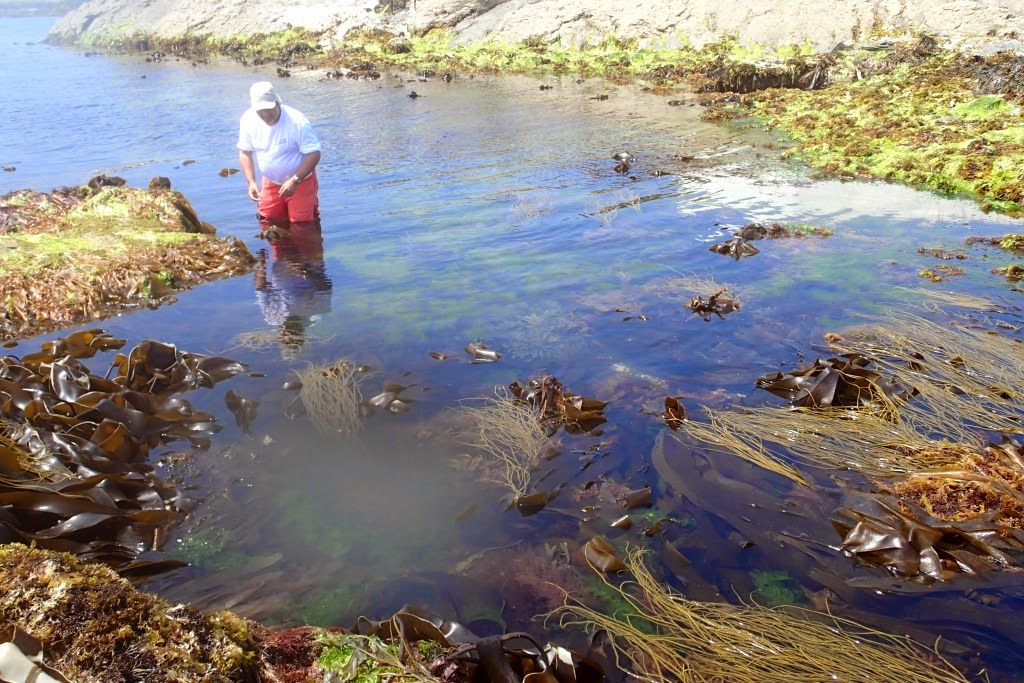
To finish off the Mega Shoresearch weekend in style the Shoresearch volunteers and I drove up to the Helford for a public event called 'Crabs and Critters'. The sun came out and the weather was fabulous. Approximately 40 people joined myself and the Shoresearch volunteers to explore this muddy but highly producive shore on Bar beach next to Helford passage. It was amazing how many species were found and a stream of excitable kids clutching crazy creatures kept myself and the Helford marine conservation group volunteers busy answering loads of questions! Top finds included a beautiful greater pipefish (I think found by Maddie Lydon) some MASSIVE velvet swimming crabs, a very strange looking hermit crab - Pagurus prideaux that lives inside a cloak anemone. Beautiful Calliactis parasitica - hermit crab anemones. Strange jelly like blobs were common in the shallows - I am still trying to find out what these are!
To round the event off in style we were lucky to be able to meet with Lynda and Simon Filmer, local fishermen who showed us a fantastic pair of large brown crabs! It was a great chance to introduce Cornwall Wildlife Trusts new project Cornwall Good Seafood Guide, which highlights the abundance of sustainably harvested seafood in our county. Lynda and Simon talked to us all about how they catch shellfish using pots and nets and we all saw first hand the power of the edible crabs pinch!
Thanks to Jake, Chloe and all the volunteers who carried out a timed species search and walkover survey, and thanks to the volunteers from Helford Marine Conservation group for a most enjoyable day!
Lynda and Simon Filmer of Filmers fish and me with a massive crab!
Pagurus prideaux in a cloak anemone - a rare find on the shore!
unidentified jelly blobs 5cm across - eggs?
Toby with a decorator crab
candystripe flat worm
Calliactis parasitica anmeone (small one) usually these are found on Hermit crab shells
Midnight Madness at Marazion! Photo copywrite Alan Barker
What an amazing experience! Despite light drizzle our volunteers only Night Rockpooling session at Marazion causeway was far better than expected! Setting out in our wetsuits and high viz vests and head torches anyone looking on must have wondered what we were up to! Crabs were out and about everywhere and seemed very surprised to be disturbed by crazy humans with torches!
Standing in the shallows our torches attracted hoards of tiny mysid shrimps, prawns and juvenile fish. We were soon joined by inch long adult atlantic cuttlefish. these guys are absolute beauties and although we had seen some on the day time survey we were treated to far more sightings on the night rockpooling!
The survey highlighted once again the incredible diversity of life on this shore and proved that night rockpooling allows you to build a much more full picture of the species present. Particularly species that are more active at night such as fish, crustaceans and cephalopods!
The first event of our Mega Shoresearch weekend was a survey and public event at Long Rock near Penzance.
Here an extensive reef of Mylor slate lies just outside the current boundary of the Mounts Bay Proposed Marine Conservation Zone. We were joined by Local marine expert David Fewick and Rob Seabold of Natural England as well as a host of keen volunteers and the slippery rocks of this impressive reef were surveyed!
Holes bored in Mylor slate by Piddocks - photo by Margaret Gardener
The slate is bored in many places by burrowing bivalves called Pidocks, themselves a rare speices to find on our coasts which have very particular geological requirements! Just to the West of the reef lies a fantastic eel grass bed which although taking a beating by our winter gales is still hanging on in there!
the tide rapidly came in and sadly I didnt make it out to the piddock holes so will definately need to visit again soon!
Despite a windy and wet afternoon we werent deterred and thanks to a fantastic new waterproof heavy duty gazebo, and the loan of Lawrence Smiths fantastic luxury gas bbq we were able to feed and water all the shoresearch volunteers and our PANACHE seasearch divers who carried out an evening shoredive near the causeway.
Sarah and the food!! - thanks to Loz from Ocean high Paddleboarding for lending us his EPIC GAS Barbecue!
PANACHE Shoresearch and Seasearchers at Mounts bay
Giant 20 kilo jellyfish up to one metre in diameter
have been making appearances in our waters reports Matt Slater, Marine
Awareness Officer with leading local wildlife charity Cornwall Wildlife Trust. Matt
along with his famous surfing dog Mango was lucky to have the opportunity to
swim with an awesome barrel jellyfish in the Percuil Estuary near St Mawes.
Many people will have seen these alien looking
creatures when on and in the water. This year has been an extremely good year
for this species that has been described as the gentle giant of the jellyfish
world! And many more jellyfish species have started turning up around our
coasts, potentially bringing with them the world’s largest marine turtle!
“It was an otherworldly experience” said Matt Slater
of his experience swimming with the giant barrel jellyfish,
“These creatures are incredibly beautiful when you
get a close look at them.
The tentacles really look like soft coral, and round
the edge of the jellyfish’s umbrella like bell there is a deep blue line
punctuated every twenty centimetres or so with a tiny dot, a sensory statocyst.
Jellies are more aware of the watery world around them than you may imagine.
They are constantly swimming up and down in the water column looking for
profitable patches of plankton. The statocysts are their sensory cells that
enable them to orientate and tell up from down.”
Like a basking shark, barrel jellies feed
exclusively on plankton which is caught with sticky mucous covered tentacles,
and like a basking shark they are fortunately totally harmless to humans, their
stings being too weak to get through human skin.
Matt Slater continues,
Lots of people have been calling Cornwall Wildlife Trust
to ask us why there are so many jellies this year. In the spring tiny anemone
like jellyfish ‘polyps’ living on the sea bed expand in size and then bud off
thousands of tiny larvae. Most years these larvae will perish but in years
where the conditions are good, temperatures are optimal, there is plenty of planktonic
food and predators do not eat them all, large numbers of them will survive
creating these huge jellyfish swarms. It is a boom and bust cycle. In fact
according to our records the last time such large numbers of Barrel jellyfish
were seen in Cornwall
was in 2002.”
On Cornwall’s
north coast huge numbers of blue jellyfish have been found. Last night Matt and
his fellow members of Holywell Bay Surf Club paddled through a swarm containing
hundreds of these blue stingers, between Holywell and Perranporth. Unlike
barrel jellies blue jellies can give a mild sting so please take care around
them if you find any. Matt reported “We also saw compass jellies and moon
jellies last night so jelly season is officially here!”
One of the most exciting things about this news is
that where there are jellyfish there is a greater chance of seeing their
predators. Two sightings of leatherback turtles have already come into Cornwall
Wildlife Trust this summer, one off Porthcurno and one in FalmouthBay. The leatherback turtle is a
prehistoric looking creature, the largest marine turtle species, growing to up
to eight foot long. It ventures north into Cornish waters in the summer months
to feed on jellies!
We urge the public to get in touch and record their
sightings of marine animals. This information is incredibly useful and
appreciated. To submit a record please use our user friendly website, www.cornwallwildlifetrust.org.uk/marinesighting
Cornwall Wildlife Trust work to protect Cornwall’s wildlife and
wild places. There are many ways you can get involved visit www.cornwallwildlifetrust.org.uk for more information.
I was privileged to have the opportunity yesterday to try out a totally new method of marine surveying. Laurence Smith of Ocean High, Marazion took me on a Stand Up Paddle board (SUP) exploration of the shallow lagoon to the East of the St Michael's Mount Causeway. This is a terrific method of exploring the shallow waters and we are hoping to go back to accurately map the eel grass beds found there.
From the high vantage point of a SUP board you can see down into the water and on a clear day like this one it meant we had a fantastic view as we glided over the surface. A video camera mounted beneath Loz'z board allowed us to capture video as we traveled. A GPS was used to record the position of the outer edges of the eel grass beds in this site.
It was a fantastic survey and we now know that a SUP is a good platform for this kind of work. As the wind started to pick up and ruffle the surface of the water I got in and snorkeled and was able to ground truth our survey area. Interestingly we found what appears to be evidence of storm damage sustained by the eel grass this winter. In many areas you can see exposed rhizomes from the eel grass and a clear step is evident where sand has been removed probably taking with it eel grass plants themselves.
Damage where the sand has been removed by storms - root like rhizomes are now exposed at the edge of the remaining eel grass rhizome matt.
Healthy eel grass Zostera marina.
Loz and the Mount
Hairy sand weed looking like coral - Cladostephus spongiosus
Leucernaryopsis cruxmelitensis Stalked jelly fish found on Ulva lactuca sea lettuce
A SUPs eye view of the lagoon - note large rainbow wrack plants, Sargassum muticum and Bifurcaria bifurcata in foreground.
Juvenile ballan wrasse - bright green to help them camoflague against the eel grass and sea lettuce
We had a great turnout of volunteers for the Shoresearch survey today at Battery Rocks right next to the jubilee pool, Penzance. My good friend Rory Goodall of www.elementaltours.co.uk was leading a fox club rockpooling event and myself and the Shoresearch volunteer team came along to conduct a survey of this important site! We were not disappointed! It is a fantastic shore! We were met by David Fenwick of www.aphotomarine.com who showed us no end of fascinating tiny creatures we wouldn't have found otherwise! I definitely need a set of reading glasses! It was great to meet Liam from Falmouth aquarium and his girlfriends dad and brother who relentlessly discovered interesting things.
Prize for find of the day was definitely the candy striped flatworm and the beautiful Risso's crab found by Rob wells who had travelled all the way from Mevagissey to be at the survey (Margaret and Tim came even further, travelling all the way from Fowey!)
I'm looking forward to heading to Mounts bay again soon - next survey / public event is at Long Rock on the 12th July!
In this gully there is a multitude of seaweed species
Cowrie grazing in a lowershore overhang
Thanks to David Fenwick for helping us find this bizzare tiny isopod Campecopea hirsuta that lives inside empty barnacles on the upper shore at this site. this one was about 3mm. You are looking at its abdomen and the spine that is sticking up is part of pereon segment 6 of its back.
Montagues blenny portrait! Ruben found 10 of these in one pool.
Rissos crab Xantho pilipes found by Rob Wells
Hairy legs are the key identification feature but they are also far more colourful than Montagu's crabs.
David found this piece of rock covered in sponge and barnacles Acaster spongites within Dysidia fragilis sponge.
I found this just sitting on a muddy ledge inside a small cave out of the water - a topknot - a type of flatfish.
Rob Wells found this beautiful large (one inch) candystripe flatworm.
Well despite having to cancel our Shoresearch at St Ives bay on Friday due to my horrendous surfing injury Shoresearch volunteers were not detered from exploring a fabulous shore on one of the most perfect days of the year so far for rockpooling!
Jake Meyers and Patrick D Arcy Evans carried on and run their own Shoresearch on the rocks next to the slipway at Smeatons Quay, St Ives and experienced the full glory of the underboulder communities to be found there! Check out some of their finds! All photos are by Jake Meyers
Excellent closeup of a beautiful long horned porcelain crab - Photo Jake Meyers
That's what I call a Topshell - extra large painted topshell - Patrick and Jake report that many things were larger at this site than anywhere else!
Beautiful bryozoans - Golden Bugula turbinata and Schizomavella sarniensis red on rock behind - a first record for Cornwall! Thanks to David Fenwick for getting this expertly identified by Mary Spencer Jones at Natural History Museum.
Corella eumota - orange tipped sea squirt - a non native species that is one of the PANACHE core species
What a repulsive fella - I think this is an Echiuran or Spoon worm called Echiura echiura - look for spines coming out of the pores if you find one.
Like something from an alien movie - Skeleton shrimps among the bryozoans.
Nice squat lobster
Bottriloides shlosseri Star ascidian - very unusual pale form